
LuckyWave KYC and Account Verification
 Available in GB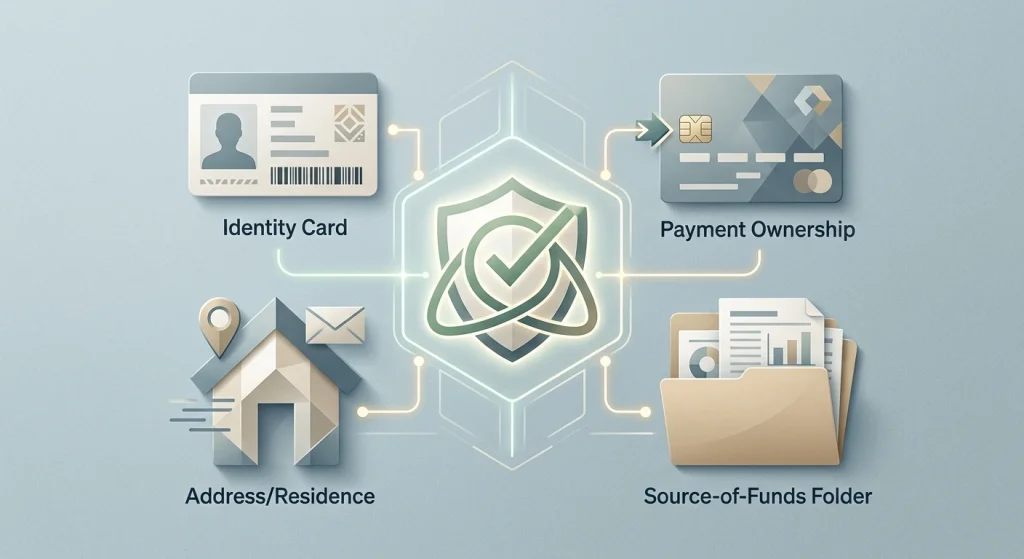
LuckyWave’s current terms allow the casino to verify a player’s identity before processing payouts. The same terms now go further than a generic KYC statement: they say requested documents can include passport details or identification cards, evidence of place of residence, source-of-funds statements and payment-system evidence. They also mention video verification in a specific document-language scenario. What the terms do not publish is a universal checklist for every account or a fixed KYC processing time. The safest reading is therefore specific: LuckyWave can request documented identity and account evidence, but the exact request depends on the case and should be taken from the protected account process rather than from a guessed checklist.
Table of Contents
- What LuckyWave explicitly says it can verify
- Identity documents
- Proof of residence
- Source-of-funds evidence
- Payment-system evidence and account ownership
- Video verification can be requested in a narrow case
- Verification before payout
- What can cause avoidable verification friction
- What the current source does not establish
- How KYC relates to registration
- How KYC relates to withdrawals
- UK regulatory context is a separate issue
- A careful verification process
- References
What LuckyWave explicitly says it can verify
The current Terms and Conditions require players to provide requested documents within specified timeframes and give examples of what those requests may cover. The listed categories include passport details, identification cards, documents confirming place of residence and statements confirming the source of funds. The anti-fraud section also refers to payment-system evidence and says the casino can check identity before processing payouts.
That source is stronger than a third-party KYC template because it describes the operator’s own contractual position. It also sets an important boundary: the examples show what can be requested, not what every player must upload in every case. The examples therefore should not be read as a universal requirement to submit every document category.
Identity documents
LuckyWave’s terms specifically mention passport details and identification cards among the documents that may be requested. In practical terms, these documents are used to connect the player account to a real person and to check whether the information entered during account setup is accurate. The terms also make players responsible for the accuracy of documents they provide and reserve the right to verify authenticity.
The current terms state no particular issuing country, mandatory driver’s licence option, selfie format or expiry threshold, so those requirements cannot be treated as established. If the account requests a particular format, the instruction inside the protected verification flow should take priority over generic internet advice.
Proof of residence
The current terms also name documents confirming place of residence. That category is distinct from proof of identity. A player can have a valid identity document and still be asked to demonstrate where they live, particularly where eligibility, payment security or account information needs to be checked.
The terms do not publish one mandatory proof-of-address document type, a maximum document age or a universal formatting rule. Because those details are absent, acceptance of a specific utility bill, bank statement or council document cannot be guaranteed. Use the exact request presented in your account rather than uploading extra personal records that were not asked for.
Source-of-funds evidence
LuckyWave’s current terms explicitly mention statements confirming the source of funds among possible requested documents. This is a more sensitive category than a basic identity check because it concerns where deposited money came from. It should not be interpreted as a claim that every player must complete a source-of-funds review; the terms frame it as one category the casino can request.
If such a request appears, respond to the requested scope rather than sending unrelated financial history. Keep copies of what you submitted and the date of submission, but avoid sharing passwords, one-time security codes or unrelated card-security information. The terms give the casino broad verification rights, but they do not remove the need for players to handle personal data carefully.
Payment-system evidence and account ownership
Payment ownership connects KYC directly to the deposit rules. LuckyWave’s terms say the company does not accept third-party payments and that deposits should be made only from payment methods registered in the player’s own name. The anti-fraud section separately refers to payment-system documents as part of account verification.
This is why the best time to reduce payment-verification friction is before the first deposit. Use your own funding method and keep the account name consistent with your payment records. If a withdrawal later triggers a check, the casino can compare identity information, account details and payment ownership instead of encountering a third-party mismatch. For the broader brand context, return to the LuckyWave review.
Video verification can be requested in a narrow case
The current anti-fraud terms include a specific provision about document alphabets. They say account-verification documents are required in Latin or Cyrillic alphabet, and if a player cannot provide documents in those alphabets, the casino reserves the right to demand video verification while the player shows the documents.
This is a good example of why source-bound wording matters. It would be misleading to turn that clause into a claim that video KYC is routine for everyone. The published rule describes a conditional situation. For a typical account, the relevant instruction is whatever verification request appears in the account itself.
Verification before payout
The terms state that LuckyWave can check identity before processing payouts and can hold refunds or withdrawals for the time needed to complete that check. They also state that false or incomplete personal data can result in a refused withdrawal and account termination. That makes KYC operationally relevant even if the account was initially usable without a full document review.
The official terms provide no verified fixed number of hours or days for verification, so a standard processing-time estimate would be unsupported. A first withdrawal, a changed payment method or a security review can all create additional steps, but assigning a standard turnaround without a source would be guesswork.
What can cause avoidable verification friction
- Inconsistent personal information. Account data that does not match identity or residence evidence can trigger additional questions.
- Third-party deposits. The terms require deposits from payment methods in the player’s own name, so using someone else’s method can create a direct ownership issue.
- Incomplete documents. The operator reserves the right to verify authenticity and act on inconsistencies, so partial or contradictory material can prolong a case.
- Sending documents outside the requested channel. Use the protected account or verification route shown by the operator rather than exposing sensitive records unnecessarily.
- Opening another account. Duplicate accounts do not solve a KYC issue and can create a separate terms breach.
What the current source does not establish
The official terms support a meaningful list of verification categories, but they do not establish several details that are often repeated on review sites. The official terms publish no fixed KYC processing time, no universal sequence showing which document is requested first, no guarantee that a particular proof-of-address format will always be accepted and no promise that a player who passed one check will never be asked for further evidence later.
Omitting those specifics is more useful than filling the gaps with standard casino boilerplate. KYC is inherently account-specific. The operator’s own request is the relevant instruction for the player, while the published terms define the boundaries around that request.
How KYC relates to registration
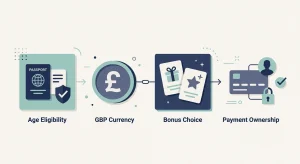
The parent account setup guide focuses on choices made when the account is created: truthful details, one-account rules, GBP, bonus selection and payment ownership. KYC is the later verification layer that checks whether those choices and records remain coherent.
That relationship is why accurate registration data matters even if no documents are requested immediately. The terms let LuckyWave compare the account with identity, residence, funding and source-of-funds evidence later. Setting up the account carefully is therefore a preventive step, not just a formality.
How KYC relates to withdrawals
Withdrawal is where many players first notice verification because the terms explicitly allow identity checks before payouts. If a cashout is pending because verification has been requested, treat the verification case and the withdrawal as linked processes. Keep the withdrawal reference, note when documents were submitted and respond to the exact information request rather than repeatedly cancelling and recreating transactions.
The withdrawal rules page covers minimum and tiered withdrawal limits separately. Those limits should not be confused with KYC processing. A player can satisfy a published withdrawal limit and still face an identity check before the payout is processed.
UK regulatory context is a separate issue
The verification terms describes the verification rights and procedures stated in LuckyWave’s own terms. It does not treat those procedures as evidence of UKGC supervision. See the UK regulatory context page for the separate regulatory framework.
Keeping those facts separate matters because a casino can publish identity-check rules without holding a local UK licence. A player deciding whether to use the service may want to consider both the operational KYC rules and the regulatory status, but they are not the same fact.
A careful verification process
- Read the exact request inside the account before preparing documents.
- Match each requested category to the source material you actually have rather than uploading unrelated records.
- Check that names, addresses and payment ownership are consistent with the account.
- Use the operator’s protected upload route and avoid sending passwords, one-time codes or unnecessary security data.
- Keep a note of the submission date and any case or withdrawal reference.
- Do not assume a fixed turnaround; the current terms do not publish one.
- If further information is requested, answer that request directly rather than opening a duplicate account or creating multiple support cases.
References
LuckyWave’s current Terms and Conditions explicitly list identity, residence, source-of-funds and payment-system evidence and contain a conditional video-verification clause. The terms do not publish a fixed KYC processing time.
Recommend

LuckyWave Games and Casino Library
LuckyWave publishes a catalogue of more than 2,000 games, with slots forming the largest visible...

LuckyWave Mobile App and Mobile Casino
LuckyWave currently promotes mobile app access for iPhone/iPad and Android through its own install page....

LuckyWave Licence, Trust and UK Regulatory Context
As of 26 September 2026, no UK Gambling Commission licence was verified for LuckyWave in...
LuckyWave Payments for UK Players
LuckyWave publishes GBP support and lists Visa, Mastercard and bank transfer for deposits, alongside Bitcoin,...

LuckyWave Bonuses and Wagering Rules
LuckyWave currently presents a four-deposit Welcome Package. The first deposit is shown as a 100%...
LuckyWave Registration and Account Setup
LuckyWave accepts adult players aged 18 or over, supports GBP, and its current general restricted-country...